Research highlights
Diffusion, RL, VLMs, and Gaussian Splatting for autonomous driving and mobile robots.
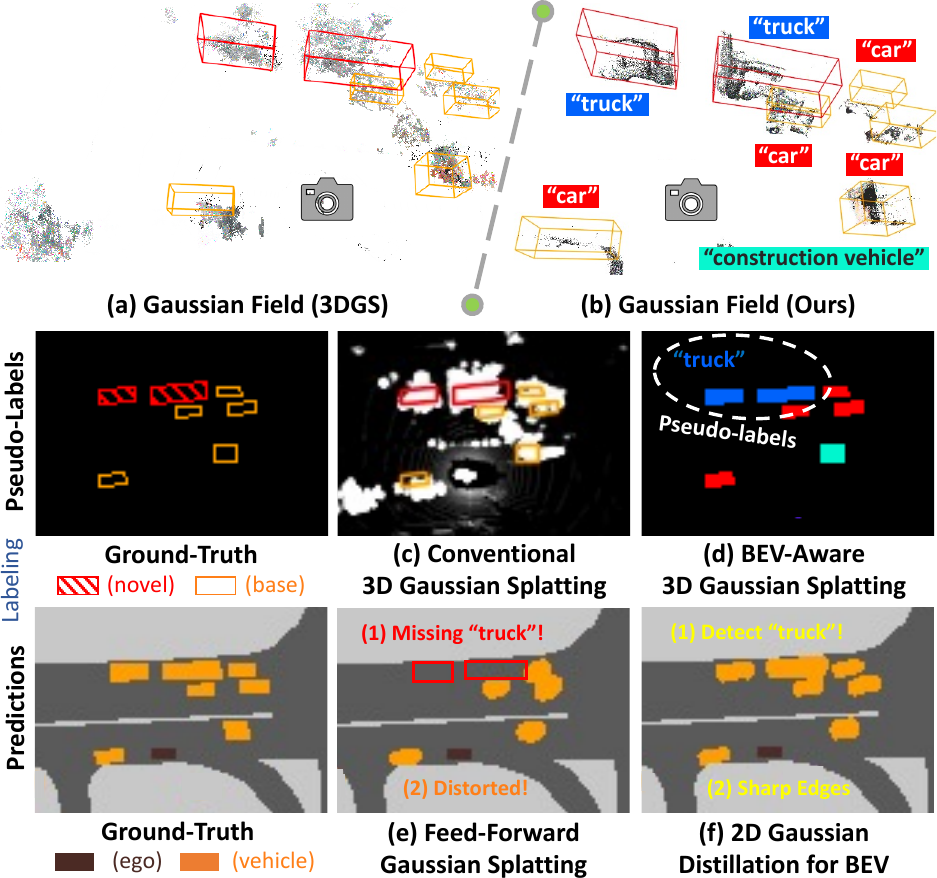
Open-Vocabulary BEV Segmentation with 3D-Aware Geometric Constraints
Open-world bird's-eye-view perception that recognizes unseen categories while preserving 3D geometry and real-time efficiency using 3DGS.
Result: +15.3 mIoU on unseen categories, 2.5x faster inference, and 0.22x memory.
Connecting Language to Space: Semantic Mapping for Mobile Robot
Developing VLM/LLM-based semantic mapping and retrieval for Mobile Robot, building on ConceptGraphs to represent objects, locations, and spatial relationships in an open-vocabulary 3D scene graph.
Goal: Ground natural-language requests in mapped objects and locations to support robot task planning in company Building.
Learning to Navigate as a Team: Cooperative Multi-Robot Navigation
Graph-attention multi-agent reinforcement learning for cooperative navigation, with centralized training and decentralized execution that requires no inter-robot communication.
Result: Learned to queue, yield at intersections, and resolve conflicting paths among 10 robots without collisions in the evaluated scenarios.
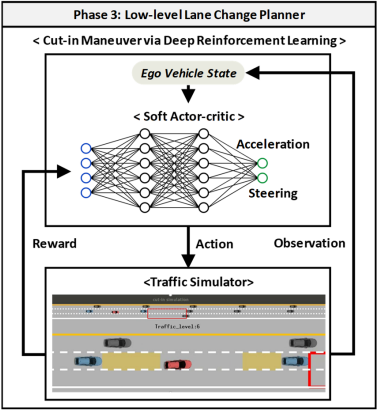
Autonomous Vehicle Cut-In Algorithm for Lane-Merging Scenarios via Policy-Based Reinforcement Learning Nested Within Finite-State Machine
A structured driving policy that combines interpretable state transitions with learned decision-making for interactive lane merging.
Venue: IEEE Transactions on Intelligent Transportation Systems.