Closed-loop multi-agent rollout by Flow-ERD — pedestrians stream across the
crosswalk while vehicles slow and yield, every agent simulated jointly with type-correct motion.
01TL;DR
Modern traffic simulators often look realistic but miss diverse plausible futures critical for autonomous driving.
Our Flow-ERD jointly achieves realism and diversity with agent-type-aware flow matching and entropy-regularized closed-loop distillation.
It ranks first on the WOSAC test benchmark and leads the realism–diversity Pareto front among reproducible baselines.
02Leaderboard
Realism · WOSAC 2025 Test Split
World’s #1The world’s most realistic traffic simulator — top overall realism (RMM) on WOSAC 2025
+0.0013Lead over 2nd place — wider than any gap between consecutive rivals in the top 10
1stKinematic metric — already best with the AFM backbone alone
Crowded lot — creeping through pedestrians between parked cars.
Highways & complex layouts
Dense highway — smooth lane-keeping over a long segment.
Complex layout — irregular topology, no off-map drift.
04Diversity
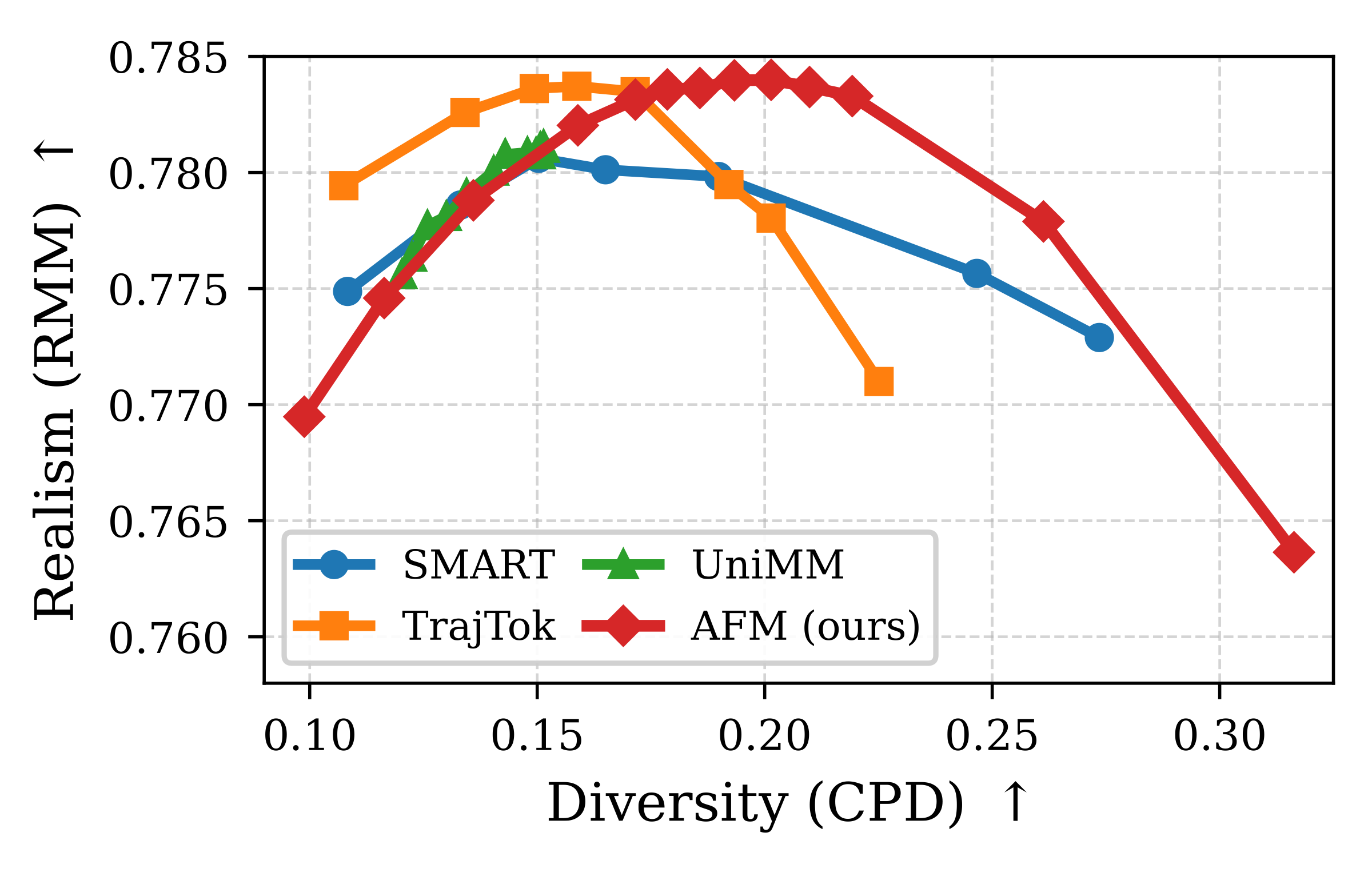
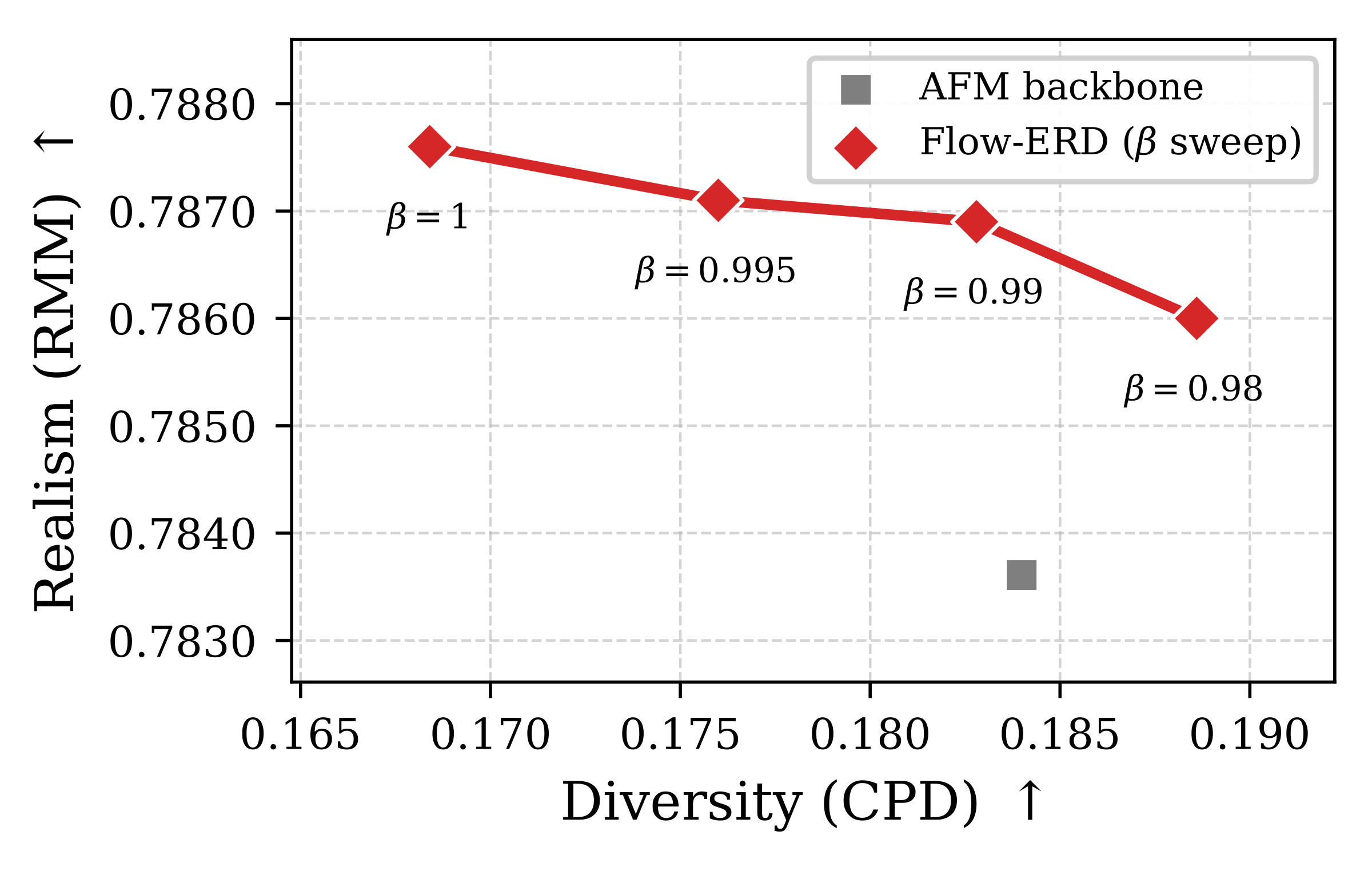
Realism–diversity Pareto front · WOSAC 2025 validation split
Backbone: AFM (ours) traces the upper-right frontier — no baseline reaches it under any sampling setting.
Fine-tuned: ERD lifts realism far above the backbone; lowering β buys even more diversity at a tiny realism cost.
Type
Method
RMM ↑
Kinematic ↑
Interactive ↑
Map ↑
CPD (diversity) ↑
Pretrained
SMART
0.7807
0.4873
0.8071
0.9144
0.1655
TrajTok
0.7837
0.4851
0.8110
0.9193
0.1587
UniMM
0.7812
0.4863
0.8070
0.9165
0.1514
AFM backbone (ours)
0.7836
0.4914
0.8096
0.9172
0.1858
Fine-tuned
CAT-K (on SMART)
0.7842
0.4904
0.8110
0.9175
0.1491
RoaD
0.7847
0.4904
0.8116
0.9182
0.1585
RLFTSim
0.7848
0.4895
0.8116
0.9190
0.1510
DecompGAIL
0.7854
0.4912
0.8123
0.9190
0.1420
Flow-ERD (ours, β = 1.0)
0.7876
0.5063
0.8108
0.9184
0.1684
Flow-ERD (ours, β = 0.99)
0.7869
0.5053
0.8099
0.9182
0.1828
Highest diversity at the highest realism — every baseline trades one for the other.
05Intent-level multimodality
Is the extra diversity meaningful, or just noise? · 64 closed-loop rollouts per scene · 1,048 WOMD validation scenes
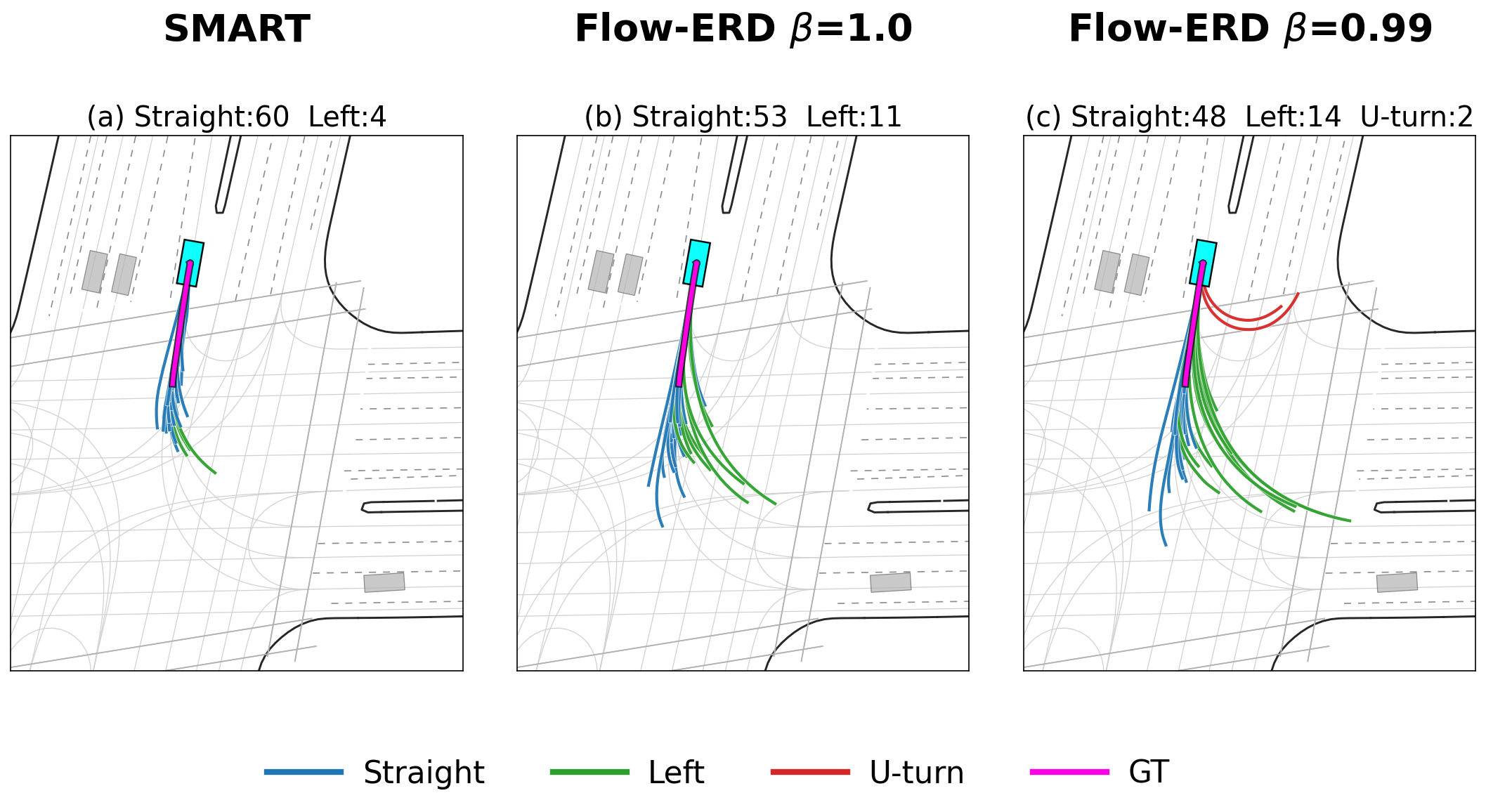
Same scene, 64 rollouts — ego trajectories overlaid on one WOSAC intersection and
colored by maneuver intent (magenta = logged ground truth).
SMART piles 60/64 rollouts onto the dominant straight mode. Flow-ERD β = 1.0 nearly triples the
left-turn mode, and β = 0.99 recovers even the rare U-turn — every branch a distinct,
physically plausible maneuver, not off-map drift.
Average per-scene intent entropy Shannon entropy of ego-intent labels, in nats · scale 0–0.5 · higher = more balanced maneuvers
SMART
0.400
Flow‑ERD β = 1.0
0.425
Flow‑ERD β = 0.99
0.477
Each ego rollout is labeled with the official WOMD trajectory-type rule; per-scene entropy is computed
over the moving intents (Straight / Left / Right / U‑turn) and averaged over all 1,048 scenes.
Entropy rises monotonically as β decreases.
Why RMM alone isn’t enough
RMM scores rollouts against a single logged future, so it under-rewards rare but plausible
alternatives — a simulator can look perfectly realistic while collapsing onto the dominant mode.
Intent entropy shows the diversity Flow-ERD preserves is semantic: distinct maneuvers
available in the same scene, with the entropy temperature β acting as a
direct dial between realism and mode coverage.
06Model overview
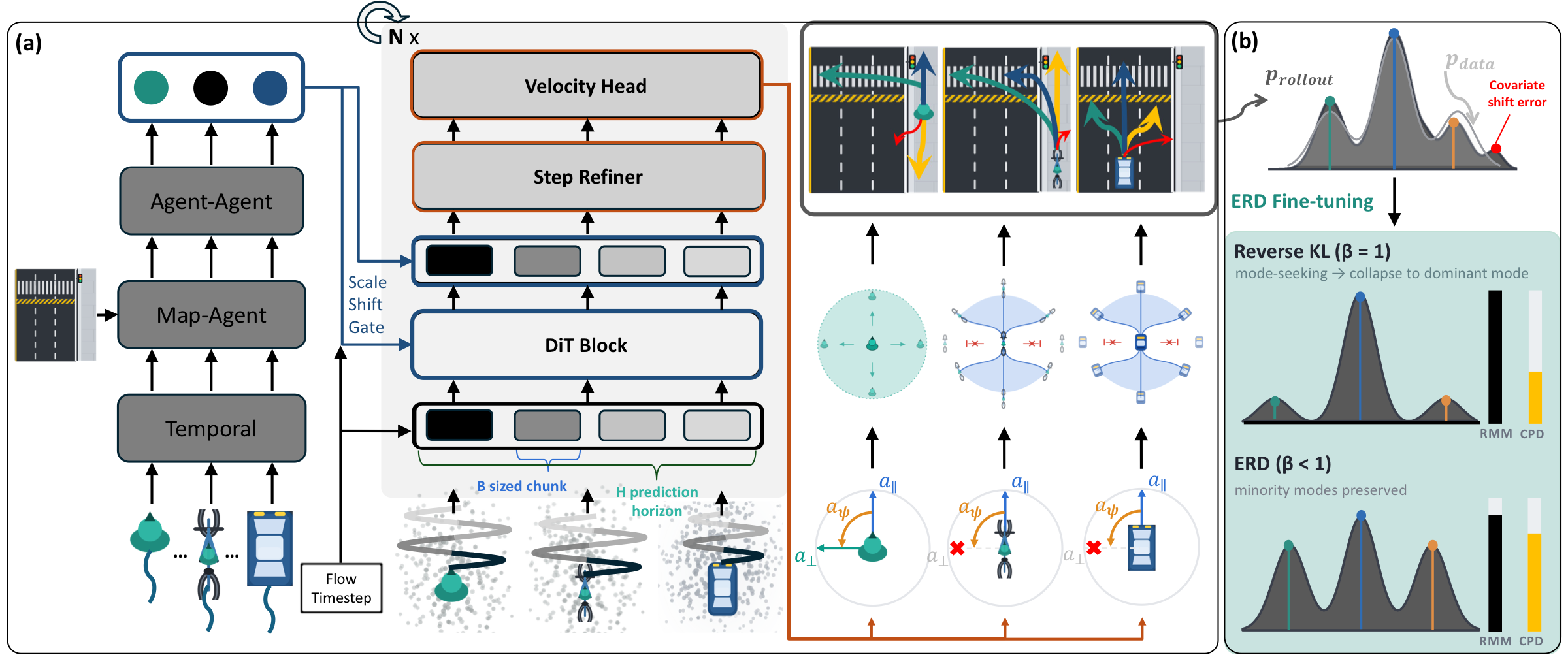
(a) AFM generates continuous actions, executed through per-type kinematics.
(b) ERD distills the closed-loop distribution toward an entropy-tempered target that keeps minority modes alive.
07Two ingredients
AFM — Agent-Type Aware Flow Matching
Flow matching samples fine-grained continuous actions — no token codebook.
Type-specific kinematics (holonomic for pedestrians, bicycle-style for vehicles and cyclists)
make physically invalid motion impossible by construction.
ERD — Entropy-Regularized Distillation
Closed-loop fine-tuning with reverse-KL against an entropy-tempered target
pdataβ, β ≤ 1: covariate shift is corrected while
rare maneuvers — U-turns, unprotected lefts — survive instead of
collapsing into the dominant mode.
08Abstract
Realistic and diverse traffic simulation is essential to autonomous driving development. Yet
prevailing benchmarks predominantly reward realism, and recent methods have optimized accordingly,
leaving diversity underexplored. We introduce Flow-ERD, a multi-agent simulator that pursues realism
and diversity jointly. Its backbone, Agent-Type Aware Flow Matching (AFM), couples flow
matching’s multi-modal expressiveness with type-specific kinematic execution. It preserves
fine-grained diversity while keeping motions consistent with each agent type. A second stage,
Entropy-Regularized Distillation (ERD), fine-tunes the closed-loop rollout distribution with an
entropy-regularized reverse-KL objective. This mitigates covariate shift while explicitly preventing
collapse onto high-density modes. We evaluate Flow-ERD with a log-free diversity metric alongside
standard realism scores. Flow-ERD ranks first on the WOSAC test benchmark and dominates the
realism–diversity Pareto front among reproducible baselines.
09BibTeX
@misc{hwang2026flowerd,
title = {Flow-ERD: Agent-type Aware Flow Matching with Entropy-Regularized
Distillation for Diverse Traffic Simulation},
author = {Hwang, Seulbin and Om, Kiyoung and Kim, Daejung and Lee, Jinhan},
year = {2026},
eprint = {2607.06957},
archivePrefix = {arXiv},
primaryClass = {cs.RO},
url = {https://arxiv.org/abs/2607.06957}
}